
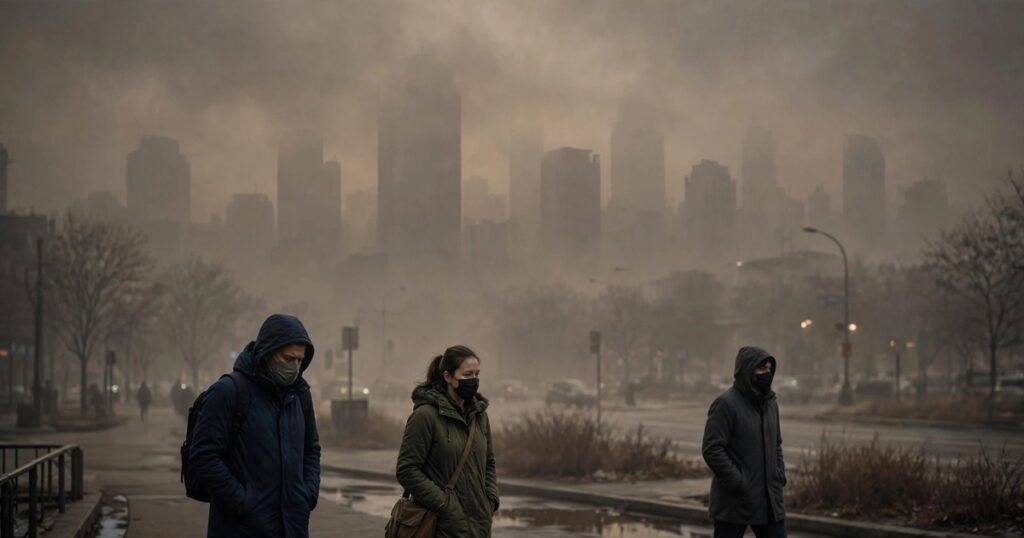
Lahore’s air turned hazardous on the morning of Monday, 2 November 2026, with the city’s Air Quality Index (AQI) reaching 535 at 8am and fine particulate matter (PM2.5) measured at 343 micrograms per cubic metre, according to The Express Tribune, which said the reading was reported by IQAir and confirmed by the Punjab Environmental Protection Department (EPD).
The reading placed Lahore in the hazardous band of the US AQI scale and was among the sharpest pollution spikes of the 2026 smog season, the Tribune reported. The episode was not limited to Lahore: Gujranwala recorded an AQI of 606 in the same morning snapshot, later rising to 675 in a separate hourly update, while Faisalabad and Multan each recorded 310 and Sialkot 260, according to Dawn’s reporting of the morning figures.
Lahore topped IQAir’s ranking of major cities in an early-morning snapshot, though both sources note that rankings and readings fluctuated through the day. The 535 figure is therefore a morning snapshot, not a fixed reading for the whole day.
The deterioration has raised fresh questions about anti-smog enforcement. The Tribune cited agricultural burning, industrial emissions, vehicular pollution and construction dust as continuing contributors, and reported satellite analysis showing 13,241 fire spots in Pakistani Punjab between 1 and 29 October, about 92 per cent of them on farmland.
A Pakistan Air Quality Initiative assessment found average PM2.5 across 26 Lahore monitoring sites fell 27 per cent in October compared with a year earlier, but its weather-adjusted estimate put the improvement from factors other than weather at only around 4 per cent, and PM2.5 stayed above Pakistan’s prescribed daily limit on every day of October.
PM2.5 particles are small enough to penetrate deep into the lungs and enter the bloodstream, increasing the risk of respiratory and cardiovascular problems, with children, older people, outdoor workers and people with existing respiratory conditions most vulnerable. 24NewsHD reported that the Punjab Health Department advised residents to stay indoors unless necessary, keep windows and doors closed, and wear a face mask. EPD spokesperson Sajid Bashir said October’s air was better than last year thanks to provincial efforts, and that work to tackle pollution was continuing.
Sources: The Express Tribune, “Lahore’s AQI soars to 535 early morning as air pollution reaches hazardous levels”, 2 Nov 2026; Dawn reporting of 2 Nov 2026 morning AQI figures (Lahore 535, PM2.5 343; Gujranwala 606, later 675; Faisalabad/Multan 310; Sialkot 260), as summarised 2 Nov 2026; 24NewsHD, “With AQI 535, Lahore again becomes world’s most-polluted city”, 2 Nov 2026 (health-department advice only — do NOT present the world-ranking claim as current, because rankings fluctuated during the day).
Note: This image is an AI-generated illustration and is not a photo of the actual event.