
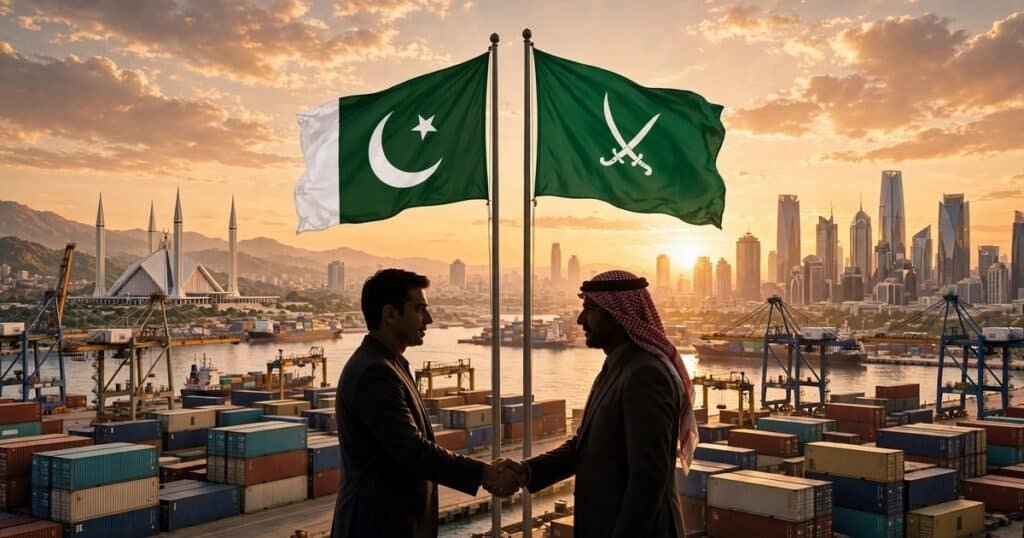
Pakistan and Saudi Arabia have discussed accelerating the signing and implementation of a proposed free trade agreement between Pakistan and the Gulf Cooperation Council (GCC). Commerce Minister Jam Kamal Khan met Saudi Ambassador Dr Rajeh Albugamy in Islamabad on October 31, 2026.
What the talks covered
The commerce minister identified improved market access, trade and investment as potential benefits of the agreement. Discussions also addressed Saudi Arabia’s Vision 2030 diversification agenda and Pakistan’s industrial and agricultural capabilities.
Both sides discussed production quality, modern technology, competitiveness and regional connectivity. They agreed to continue coordination on trade, investment and agriculture, according to reporting on the meeting.
Where the agreement stands
Pakistan and the GCC concluded negotiations in September 2023, but the agreement had not yet been formally signed and implemented at the time of the November reporting. Earlier comments by Deputy Prime Minister Ishaq Dar suggested that approval from a GCC member could still be outstanding.
The GCC comprises Bahrain, Kuwait, Oman, Qatar, Saudi Arabia and the United Arab Emirates. A Pakistan-GCC agreement is therefore broader than a bilateral Pakistan-Saudi trade arrangement.
What a free trade agreement could mean
A free trade agreement can reduce or eliminate tariffs on qualifying goods, subject to the negotiated schedule. It may also address customs procedures, rules of origin and other conditions governing preferential access. The final text determines which products benefit, how quickly tariff changes take effect and whether exceptions apply.
For Pakistani exporters, potential opportunities could include food products, textiles and manufactured goods. However, preferential tariffs alone do not guarantee sales. Businesses must still meet buyer requirements, quality standards, delivery commitments and any applicable import regulations.
What businesses should do now
Exporters can prepare by reviewing product classifications, origin documentation and destination-market standards. They should not quote preferential duties to customers until the agreement is in force and the relevant tariff schedule is published.
The next milestones are formal signing, any required approvals and publication of implementation arrangements. Until those steps are completed, existing trade rules continue to govern shipments. The October meeting signals political interest in advancing the deal, rather than an immediate change in customs duties.
Note: This image is an AI-generated illustration and is not a photo of the actual event.