
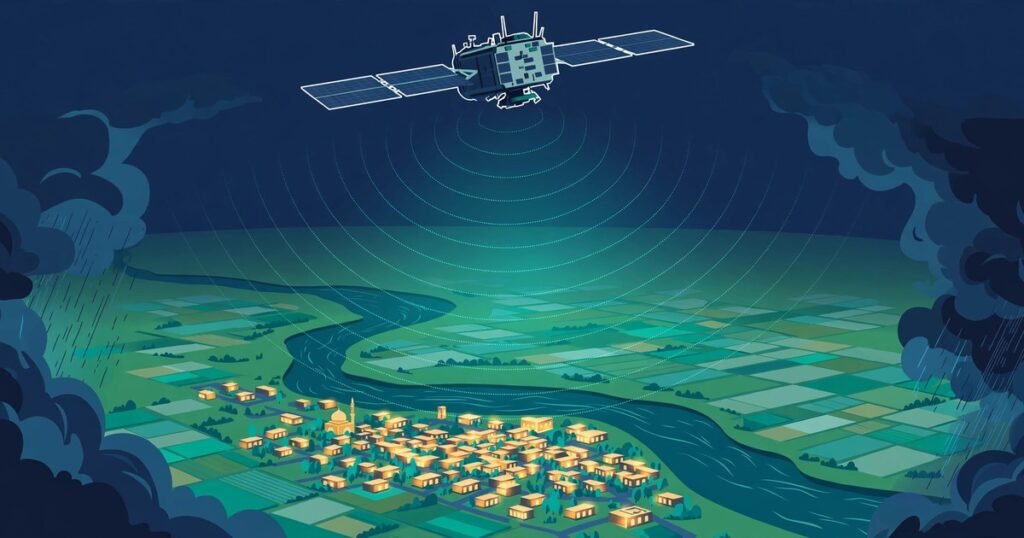
Pakistan should move its disaster management from reactive response to prevention, Federal Minister for Climate Change and Environmental Coordination Dr Musadik Malik said on Saturday, calling for satellite technology, artificial intelligence and accurate early-warning systems to identify risks before they turn into disasters.
Speaking at the closing ceremony of the five-day UN/Pakistan International Conference on “Leveraging Space Technology for Early Warning for All (EW4All), Climate Action and Disaster Risk Assessment”, hosted by the Pakistan Space and Upper Atmosphere Research Commission (SUPARCO) in Islamabad, the minister said scientific data must be turned into practical, timely interventions to prevent loss of life and property.
“A warning without an address is a warning addressed to no one,” he said, as reported by Business Recorder — arguing for precise, location-specific alerts that reach individual households and vulnerable communities, rather than broad regional forecasts. He compared early diagnosis in medicine with scientific monitoring: just as timely treatment can prevent surgery, accurate forecasting should help prevent disasters and minimise their impact.
The tools he named were satellite imagery, radar, hyperspectral data, artificial intelligence and advanced predictive modelling. He called for annual satellite-based reports on floodplains and encroachments, stronger coordination among institutions and across borders, accurate mapping of disaster-prone areas, and greater involvement of young innovators through collaborative research, hackathons and innovation initiatives. Rescue operations, he said, should be the last resort rather than the first response.
The conference brought together around 250 participants from Pakistan, including federal and provincial ministries, academia and national institutions, as well as delegates and representatives from 22 countries. It featured 17 sessions, including two high-level plenary sessions, five panel discussions and 10 technical sessions, with 67 presentations. SUPARCO Chairman Muhammad Yousaf Khan said the real value of satellite technology lay in translating space-based information into timely decisions and practical action.
Sources: Dawn, “Minister calls for shift to disaster prevention, stresses use of satellite technology, AI” (1 Nov 2026); Business Recorder, “Musadik calls for accurate early warnings to identify disasters” (1 Nov 2026). Both report the same Saturday closing ceremony, the same shift from reactive to preventive action, and the same annual satellite-based floodplain/encroachment reports.
Note: This image is an AI-generated illustration and is not a photo of the actual event.